We’ve all experienced that moment of loneliness in our professional careers. The one where you’ve planned the perfect hardware upgrade for your infrastructure, but a trivial detail disrupts the whole operation. Recently, we had to replace the 3.5-inch mechanical drives in one of our 4-node clusters with 2.5-inch SSD drives. A classic maintenance operation to move from hybrid storage to full-flash and gain some IOPS.
The only problem, and a big one: the original server caddies weren’t compatible with this smaller form factor.
First approach: “official” adapters
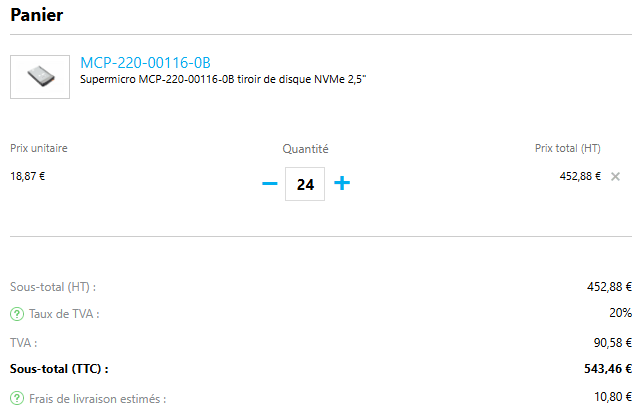
The obvious solution when managing a pro infra? Order official adapters or replacement caddies. We needed 24 pieces in total (6 drives for each of the 4 nodes). And then, reality hit hard.
Over 500 euros (including taxes and shipping).
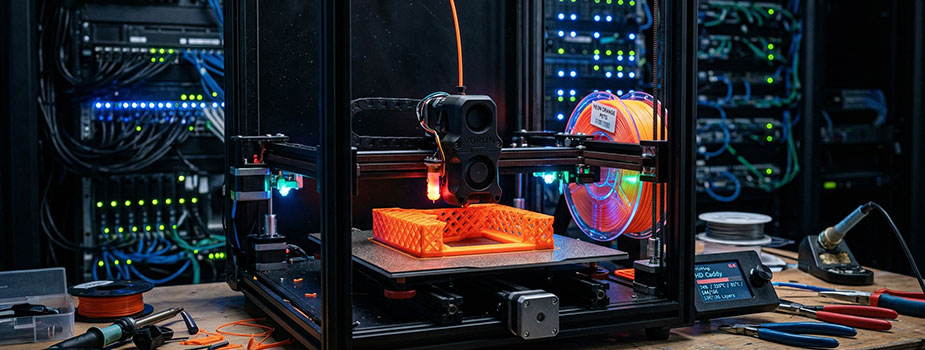
But the worst part wasn’t actually the price: it was the lead time. Waiting several weeks when the project had to move forward? Unthinkable. Since I refused to pay this tax and wait, my 3D printer was going to take care of it.
Plan B: the DIY solution
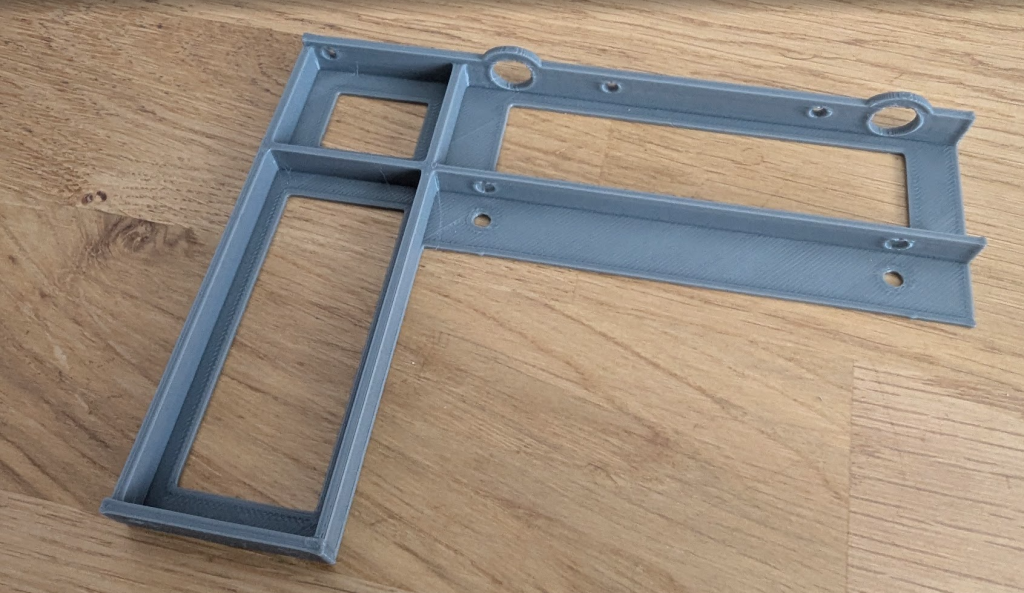
The advantage of having standard hardware like Supermicro is that you’re never the first to encounter a problem. No need to spend hours on Fusion 360 modeling the part to the nearest millimeter: the open-source community has probably already done it.
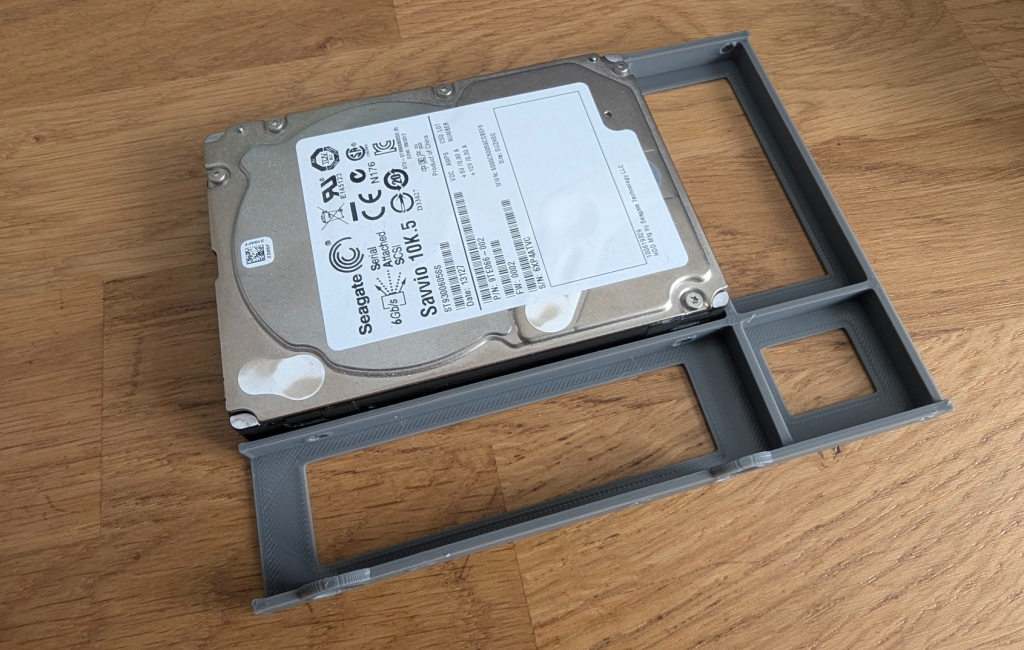
To ensure compatibility, I quickly printed one to validate the dimensions and make sure it did the job…
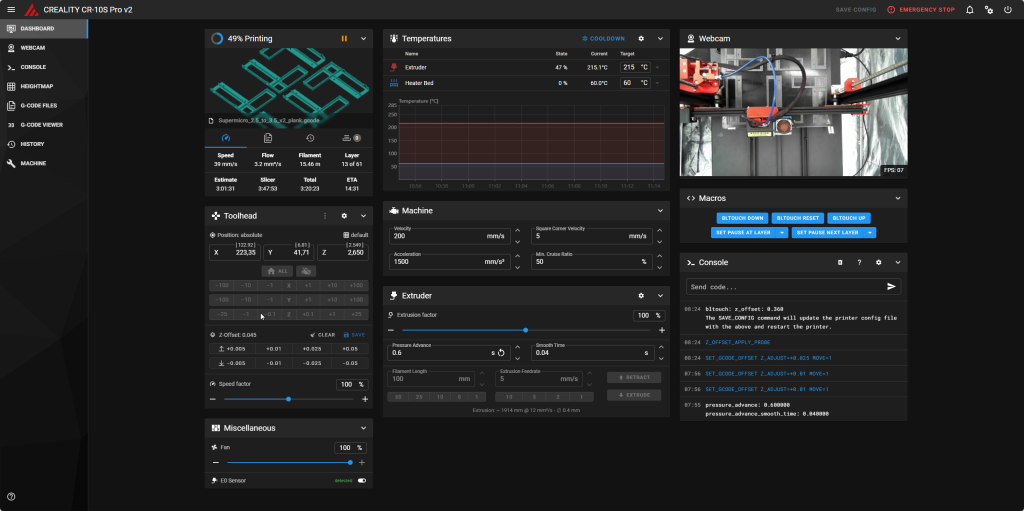
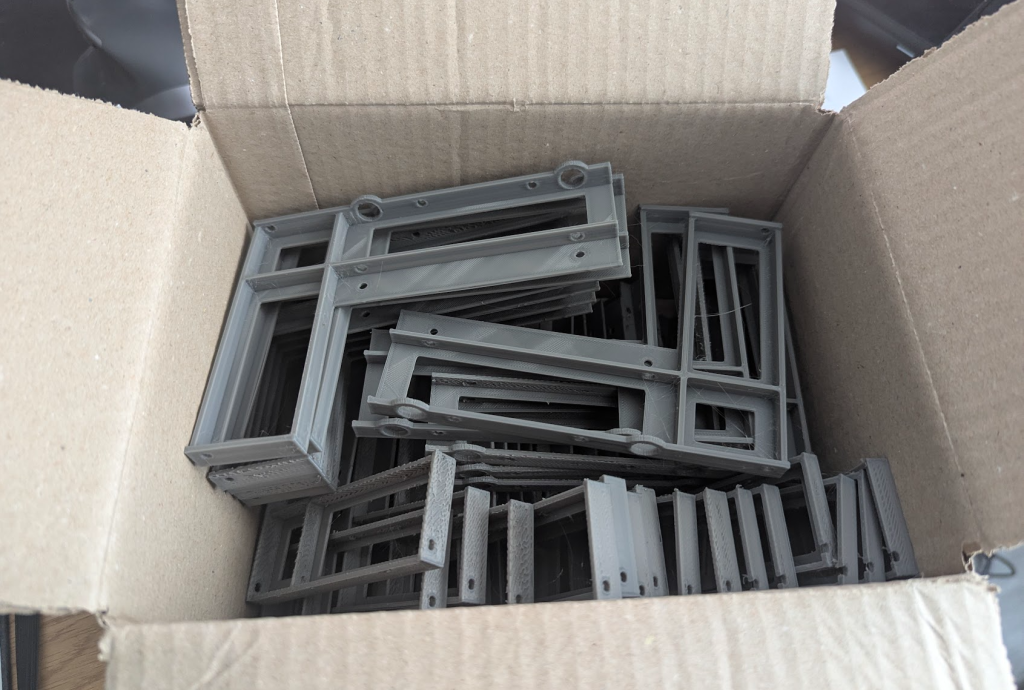
The next step: industrialization. I positioned my models so I could print 6 adapters at once. This meant leaving the printer running for about 7.5 hours for each build plate.
On my Creality CR-10S Pro v2 running Klipper, I was able to monitor the print job to ensure everything went as planned out of the corner of my eye while continuing to work on my projects.
Despite a slight hiccup during the first batch that forced me to do a bit of mechanical tweaking, the prints went perfectly well.
Maker Spirit for the Win!
The final verdict is clear:
Vendor Option: ~€543 and a 3-week wait.
Maker Option: €20 of filament, a few kWh, and two solid days of printing.
Beyond the obvious financial savings (for the price of the official adapters, we could have bought the printer + the filament), the real lesson of this adventure is that the maker mindset allows you to transform a budgetary and temporal problem into a DIY solution that is 20 times cheaper and gets the job done in ultra-short timeframes.
So, the next time a problem rears its head, think “out-of-the-box” and, if need be, whip out your finest spool of filament.
In the world of infrastructure, we know that every cluster must be monitored. We never launch a major update without checking the node status and ensuring redundancy. For our professional and personal lives, it should be the same.
2025 is coming to an end, and if I had to summarize this year, it wouldn’t be a simple hot migration, but a true architectural evolution, with a few production incidents. It’s time for a full Health Check. No filters, just data, infra, and feelings.
Here is my post-mortem audit of 2025 and my roadmap for 2026.
2025: Unfiltered Retrospective (The Health Check)
This year marked a critical turning point in my career: my first full year as a Team Lead, while remaining a Senior Consultant expert in hyperconverged infrastructures at a Nutanix Pure Player: Mikadolabs.
From Technical Expert to Team Lead
For the uninitiated, moving from “Senior Consultant” to “Team Lead” is a bit like moving from managing a single cluster to orchestrating an entire datacenter. The scale changes. We no longer just manage IOPS and latency, but humans and planning.
On paper, the blueprint was clear. In reality, execution requires constant vigilance.
Overall, the stack held up. The team delivered, and infrastructure projects were successfully completed. I learned to delegate operational tasks (sometimes painful for a purist) to focus on organization and process improvement. Seeing a team member skill up on complex subjects, not necessarily technical ones, thanks to my guidance brought me a different satisfaction, but just as powerful as resolving a critical outage.
Let’s be transparent: everything wasn’t smooth. The hardest part for an ultra-technical profile like mine is stepping away from the console.
I like getting my hands dirty, tuning performance, auditing clusters. Becoming a Team Lead meant accepting spending less time on Prism Element or the command line, and more time in meetings or planning. I sometimes felt like I was losing my direct “connection” with tech, that imposter syndrome that stalks those who move away from production.
It’s a precarious balance that I continue to adjust for 2026: remaining one of the team’s expert references without becoming a bottleneck.
2025 in Data: Log Analysis
A good architect doesn’t rely on guesswork; they look at the metrics. And this year, if I hadn’t opened my dashboards, I would have had a totally biased view of my own performance.
That’s where data becomes relevant: it doesn’t lie, unlike our brain which tends to erase successes to focus on shortcomings.
The Blog: “Scale-Out” Growth
The traffic figures are quite good for a personal tech blog.
The KPIs of the year:
Production:60 articles published (an average of 5 articles/month). Swiss clock regularity.
Traffic: 39.3k Views (+868%) and 23.8k Unique Visitors (+924%). Note: The growth figures compared to 2024 are a bit biased because the tool I used to track blog traffic changed in the last quarter of 2024.
Engagement: A community growing on LinkedIn that is starting to comment and interact, a sign that my content is finding its target.
We observe a direct correlation between publication density (especially the peaks in May and the regularity of the last quarter) and the explosion of organic traffic. It is proof by example that technical SEO, coupled with in-depth content (not simple ChatGPT articles), pays off over time. The blog has gone from “confidential” status to a true consulted resource. Many clients (not to say “all”) have already told me they read the blog regularly. Thank you, that’s what drives me to continue!
Sport: The Perception Bug
This is where the retrospective becomes surprising. If you had asked me yesterday: “Julien, were you athletic this year?”, I would have answered with frustration: “Yes, but not regular enough for my taste, I feel like I’ve stagnated”.
So I extracted the logs of my activities (Running and Cycling, thanks Strava) to see the extent of the damage. And there, surprise: the logs contradict my mental monitoring.
Activity
2024 (Baseline)
2025 (Prod)
Differential
Running
106 km
487 km
x 4.5
Cycling
444 km
1987 km
x 4.5
It’s a textbook case of a “False Positive”. My brain focused on the “off” weeks (only 2 weeks out of 52 with 0 activity), forgetting the global volume.
In reality, I multiplied my activity volume by 4.5 compared to 2024. I covered nearly 2500 km all sports combined. That’s not too bad, but I intend to do better in 2026!
The lesson for 2026? Trust the data. Like in prod, when you think there is a latency problem, you look at the curves first before rebooting. I wasn’t “irregular”, I simply changed scale without realizing it.
2026 Goals: My Tech Radar & Roadmap
A review is useless if it doesn’t allow updating the roadmap. For 2026, I don’t foresee a revolution, but a targeted evolution of my technical and personal stack. The goal? Reduce technical debt and prepare for the future.
1. Tech Watch: K8s and AI (Pragmatic)
There are two major subjects on which I intend to skill up, not out of “Hype”, but out of operational necessity:
Kubernetes (K8s): It has become unavoidable. Even in a hyperconverged world, container orchestration is the standard upper layer. It’s a subject I’ve put off for a long time, due to lack of time. So I want to learn the basics, and go beyond to master architecture and advanced troubleshooting.
AI (User & Integrator): I’m not talking about playing with prompts to generate images of cats or parody songs. My goal is twofold: optimize my daily workflow (AI as an assistant) and above all understand how to technically integrate it into solutions (API, automation). AI will not replace the architect, but the architect who uses AI will replace the one who doesn’t.
2. Side Project: Automated Audit
This is the big “Dev” chunk of the year. As a consultant, I spend a lot of time auditing infrastructures. I am working on developing an automated audit application.
The idea is simple: script intelligence and recurring checks to save time on data collection and focus on high value-added analysis. It’s a project that mixes my infra skills and my desire to code. Stay tuned, I’ll surely talk about it here again.
3. Human Infrastructure: Preventive Maintenance and MCO
Finally, let’s talk about my Hardware: my body.
The 2025 logs showed me that the machine is capable of handling the load, but the configuration will have to be optimized. My 2026 goal is to invest a little more in my health just as one invests in critical infrastructure:
More sport: Continue the momentum of 2025 to aim for absolute regularity and increase volume with more structured training.
Less stress: Better partition professional and personal life, and learn to pick my battles.
Healthy Food: Pay a little more attention to my diet to boost the benefits of physical activity.
My wishes for you: Be curious, be resilient
To conclude this first publication of 2026, I won’t settle for the usual formulas. In 2026, I wish you two essential qualities: Curiosity and Resilience.
Don’t be intimidated by the mountain. Computer science, like any field of expertise, is tamed step by step. Be curious, dare to test, dare to make mistakes. It is the only way to learn.
I also wish you Resilience. In our projects as in our lives, everything never goes exactly as planned on paper. There will be unforeseen events, errors, moments of fatigue. It’s okay.
True strength is not never falling, but knowing how to bounce back. Be lenient with yourselves when it doesn’t work on the first try. Accept the downtime, learn, and restart. That is true sustainable performance.
You might think that over time, you get used to it. That after two years, opening the email announcing the results becomes a mere administrative formality. Well, I must confess: not at all.
It is with immense pride – and undisguised relief – that I announce my nomination as a Nutanix Technology Champion (NTC) for the year 2026. This is the third consecutive year that I have the honor of joining this group of passionate experts.
To be completely transparent, I never take this distinction for granted. In the IT world, technologies evolve fast, and so do we. Staying relevant requires work, curiosity, and above all, the desire to share. Seeing my name once again on the official NTC 2026 list is a beautiful validation of the efforts put into the blog throughout the year.
What is an “NTC”? (Spoiler: It’s not just a LinkedIn badge)
I am often asked if it is an exam I passed, like an NCP-MCI certification. The answer is no, and that is precisely the beauty of this program.
The Nutanix Technology Champion program does not just reward passing a technical multiple-choice quiz. It is a distinction that recognizes community engagement. Basically, Nutanix spots those who spend their free time testing, breaking, fixing, and above all explaining their technologies to others. Whether through blog posts (like here), forum contributions, or talks at events.
For the purists, it is the equivalent of the vExpert at VMware or the MVP at Microsoft. It is the validation of what we call technical “Soft Skills”: the ability to evangelize a solution not because we are paid to do so, but because we master its intricacies and we love it. It is a recognition by peers and by the vendor, and that is what makes it so rewarding.
Under the Hood: Why this nomination matters for the blog
Beyond the shiny logo to put in a signature, being an NTC has a direct impact on the quality of what I can offer you on juliendumur.fr. It is not an honorary title devoid of meaning; it is a key that opens interesting doors.
Concretely, this status gives me privileged access behind the scenes. I have the opportunity to exchange directly with Product Managers and Nutanix engineering teams. This means that when I write a technical article, I can validate my hypotheses at the source, avoiding approximations.
Furthermore, we have access to roadmap briefings and Beta versions. Even if this information is often under NDA (I can’t reveal everything to you in advance!), it allows me to understand the direction the technology is taking. I can thus better anticipate topics to cover and offer you more relevant analyses as soon as features reach General Availability (GA). It is the assurance for you to read content that is not only technically accurate but also in phase with market reality.
Retrospective and 2026 Goals: Full Steam Ahead
This third nomination is the fruit of consistency. But above all, it marks the beginning of a new year of “lab”. The goal is not to collect stars, but to continue exploring the Nutanix Cloud Platform from every angle.
For 2026, I intend to keep offering practical tutorials and field feedback. While the AHV hypervisor remains the unavoidable foundation, I really want to move up the software stack a bit more this year. Expect to see topics covering container orchestration with NKP (Nutanix Kubernetes Platform), automation, and probably a stronger focus on security with Flow. The objective remains the same: dissecting the tech to make it accessible.
A huge thank you to the community for the daily exchanges, and of course to the NTC program team (shout out to Angelo Luciani) for their renewed trust. It is a pleasure to be part of this virtual family.
Now, the ball is also in your court: are there specific topics or features of the Nutanix ecosystem that you would like to see me cover this year? The comments are open!
I won’t lie to you: when you’ve had a taste of gold, bronze has a peculiar flavor. Last year, I had the immense pride of finishing first in the “Top Bloggers” ranking of the Nutanix Technology Champion (NTC) program.
Did I slow down? No. Did I share less? On the contrary. But in tech, just like in sports, staying at the top is often harder than getting there. This 3rd place is, above all, a signal that the competition has intensified. And honestly? It’s exactly what I needed to motivate me to get back in the fight for 2026.
The NTC Program is Not Just a Badge
For those new to the ecosystem, being a Nutanix Technology Champion (NTC) isn’t just about slapping a logo on your LinkedIn profile. It is a commitment. It means being part of a technical vanguard that tests, breaks, fixes, and—above all—documents Nutanix solutions. The “Top Blogger” ranking is the barometer of this activity.
1st in 2024, 3rd in 2025: Analyzing the Logs
So, what happened? I pulled my logs to compare. If my performance had dropped, I would have accepted this 3rd place with a shrug. But the data shows otherwise: my publication volume is equivalent to last year’s. Even better, my strategy was cleaner: instead of doing “bursts” (flurries of articles), I maintained a metronomic consistency, spread evenly over the 12 months.
The conclusion is simple and undeniable: the overall bar has been raised. My peers were absolute beasts this year. They produced more. This is excellent news for the Nutanix community: the ecosystem is alive, dense, and increasingly sharp. But for the competitor in me, it’s a wake-up call. Consistency is no longer enough; just like in cycling, I’m going to have to up the intensity.
Why Publish?
Beyond the rankings and the competition, why continue writing with such discipline? The answer is pragmatic. My blog is primarily my external memory. In our line of work, we don’t remember everything. We test, we configure, we hit a critical error, we resolve it… and six months later, we’ve forgotten how we did it. Blogging is about documenting my own “struggles” so I never have to look for the solution twice. It’s about transforming obscure troubleshooting into a clear tutorial. But make no mistake: every article is born from a real technical need, from a real infra that I built or fixed. No fluffy theory, just experience from the field. The icing on the cake: the feedback from our clients who stumble upon my blog and tell me, “We found a solution on your site.” That is the real reward.
Conclusion: See You at the Finish Line
Bravo to the two peers who finished ahead of me this year. You set the bar very high, and that is exactly what I like. The level of the NTC program is what makes it credible. But the message has been received. The consistency of 2025 was a good foundation, but for 2026, I’m shifting gears. I’m going to chase more specific topics, dig deeper into the guts of Nutanix AOS and AHV, and perhaps explore use cases that no one has documented yet.
The bronze medal is nice. But it will serve primarily as a reminder on my desk: next year, I’m aiming for the yellow jersey.
Modifying all the site’s links so they display in a new window
Redesigning the footer
These are mostly small adjustments, but they’ve been something I’ve been putting off for a long time.
I’m also, and above all, taking advantage of this vacation to rest, do activities with family, sports, tidy up, do some DIY… Activities that give your mind a rest!
We use cookies to improve your experience on our site. By using our site, you consent to cookies.
This website uses cookies
Websites store cookies to enhance functionality and personalise your experience. You can manage your preferences, but blocking some cookies may impact site performance and services.
Essential cookies enable basic functions and are necessary for the proper function of the website.
Name
Description
Duration
Cookie Preferences
This cookie is used to store the user's cookie consent preferences.
30 days
These cookies are needed for adding comments on this website.
Name
Description
Duration
comment_author
Used to track the user across multiple sessions.
Session
comment_author_email
Used to track the user across multiple sessions.
Session
comment_author_url
Used to track the user across multiple sessions.
Session
Statistics cookies collect information anonymously. This information helps us understand how visitors use our website.
Matomo is an open-source web analytics platform that provides detailed insights into website traffic and user behavior.