
NKP 2.19 at Tech Connect 2026: NKP Metal and CN-AOS
NKP (Nutanix Kubernetes Platform) was on my 2025 roadmap, I pushed it back to 2026 for lack of time, and this chaotic year has just sent it off to 2027. So I have not touched NKP 2.19: what I am telling you here comes from the sessions by Yannick Struyf and Divyansh, which I attended on October 26 in San Jose during Nutanix Tech Connect 2026, where few people in the room had tested this version released the week before.
In this article, I share what I took away about NKP Metal and CN-AOS, the two announcements that take NKP off the hypervisor, and I compare them with the documentation available today. If an acronym loses you along the way, I invite you to read my Nutanix glossary.
NKP Metal, Kubernetes on physical servers
Announced at .NEXT last April, NKP Metal ships with NKP 2.19 and deploys Kubernetes directly on physical servers, in the Pro and Ultimate editions. Yannick, Principal Product Manager for NKP, sees three uses for it: GPU-dense machines that customers want to run without an intermediate layer, the edge, where applications are now mostly containerized, and servers to reuse after leaving VMware.
Installation goes through a familiar tool. Foundation Central discovers the nodes and lays down a hardened Ubuntu image, downloaded from the Nutanix portal, on validated hardware that is limited to Dell and HPE for now, with the list expected to grow with each release. If you are not familiar with Foundation, I invite you to read my article on the subject.
Foundation is only used for the initial setup. OS updates and scaling then go through NKP, which updates the existing servers, since you rarely have spares, and relies on labels (“GPU node”, “datacenter 1″…) to add machines automatically when an application grows.
An NTC (Nutanix Technology Champion) asked the awkward question: is bare metal really faster, when some reports from the VMware side claim the opposite? Yannick answered that some workloads need direct access to the hardware, and admitted that even when a cluster on VMs reaches the same performance, some customers want their Kubernetes on physical servers, out of “mindset”. Fairly honest for the person presenting the feature.
That leaves storage. If you already have an NCI (Nutanix Cloud Infrastructure) cluster, the CSI (the Kubernetes storage driver) lets the physical nodes consume its storage. Otherwise, you will have to look at CN-AOS…
The mixed AHV and bare metal cluster
According to Yannick, this is the most frequently requested scenario, and I understand why: a highly available Kubernetes cluster needs three control planes, and dedicating three physical servers to nodes that will never use all their resources is expensive. With NKP 2.19, you deploy your cluster on AHV, with control planes and workers as VMs, then you add an NKP Metal node pool with your GPU machines.
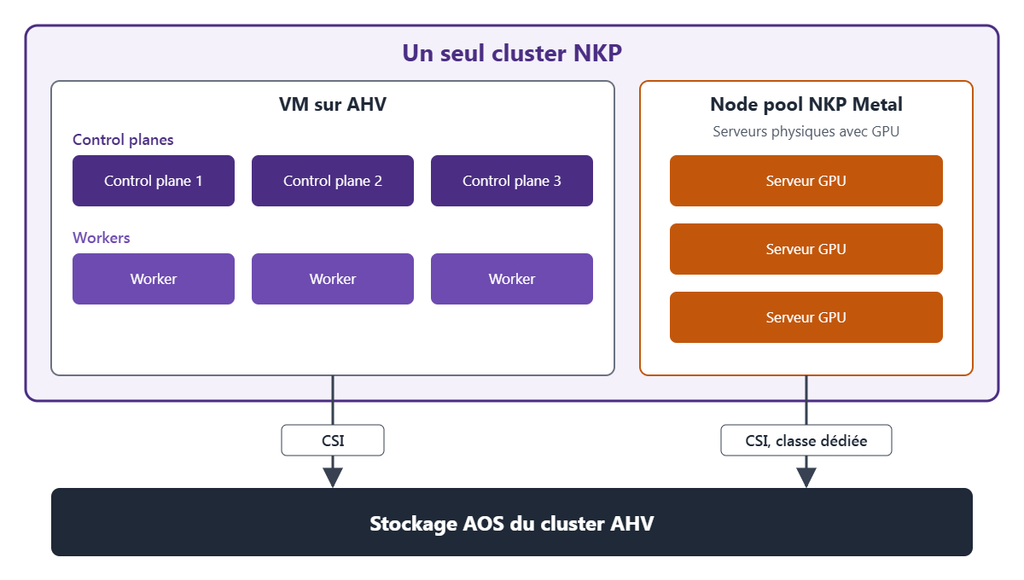
Storage was the blocker. In bare metal mode, the CSI lost track of the topology and of the volumes attached by the hypervisor. It now knows which nodes can use them, with a separate storage class for bare metal.
One NTC admitted that this gap had made their team give up on NKP two years earlier. “Huge improvement” was their verdict, and another summed up the room in one word: “Sold.”
What NKP 2.19 changes day to day
NKP Metal takes center stage, yet these changes will affect far more people.
- The unified registry: in connected environments, container images used to come from several repositories. They are converging on a single Nutanix registry, based on Docker Hub, with a token created on the Nutanix portal to deploy the management cluster. Dark sites and mirror registries are not affected. Since this effort spans the whole company, one NTC, tired of negotiating URL lists with security teams, slipped in a heartfelt “you just made my day”.
- Projects 2.0: with Prism Central 7.6, a cluster’s VMs, persistent volumes and OS images are attached to the same project, whereas you previously had to grant access to each resource separately. This makes RBAC (role-based access control) much simpler, especially for service providers.
- The AHV VM Operator: it describes a VM, Windows included, as a Kubernetes resource, and can expose it through a LoadBalancer or ClusterIP service. Unlike OpenShift Virtualization, the VM does not run inside the Kubernetes cluster: it is deployed on AHV.
Upgrades, so far done from the CLI, can now be run from the UI or declaratively with GitOps, with checks before and after the operation. The order is still dictated by the NKP 2.19 documentation (“Upgrade Nutanix Kubernetes Platform”): the management cluster first, with Kommander then the NKP CLI, and the workload clusters next, one at a time, starting with their platform applications. On a cluster managed with GitOps, control planes are replaced before workers.
CN-AOS, AOS storage without a hypervisor
Divyansh, who leads storage product management at Nutanix, starts from the question NKP Metal raises: without a hypervisor, where does the storage come from?
The answer is CN-AOS (Cloud Native AOS). The AOS storage engine runs in Kubernetes pods, the cloud native equivalent of CVMs (the controller VMs of a Nutanix cluster), and relies on the nodes’ local disks. You get thin provisioning, data locality, RF2 (two copies of each piece of data) and inline compression, with deduplication and erasure coding announced for later. The CSI exposes two access modes, RWO (write access from a single node) and RWX (from several nodes), which lets you serve a file share or home directories without buying yet another storage solution.
CN-AOS first launched on AWS, on EC2 instances orchestrated by EKS. Divyansh says it is available with NKP 2.19, promises an improved experience with NKP 2.21 and does not rule out opening it up to OpenShift on bare metal.
The documentation is more cautious: the CN-AOS 1.0.0 guide dated June 17, 2026, which predates NKP 2.19, only covers EKS. It still gives a rough idea, to be checked on NKP Metal: 3 to 15 nodes, and up to 48 GiB of memory and 16 vCPUs reserved per node. On a server bought for its resources, you will have to size for that.
NDK to protect applications
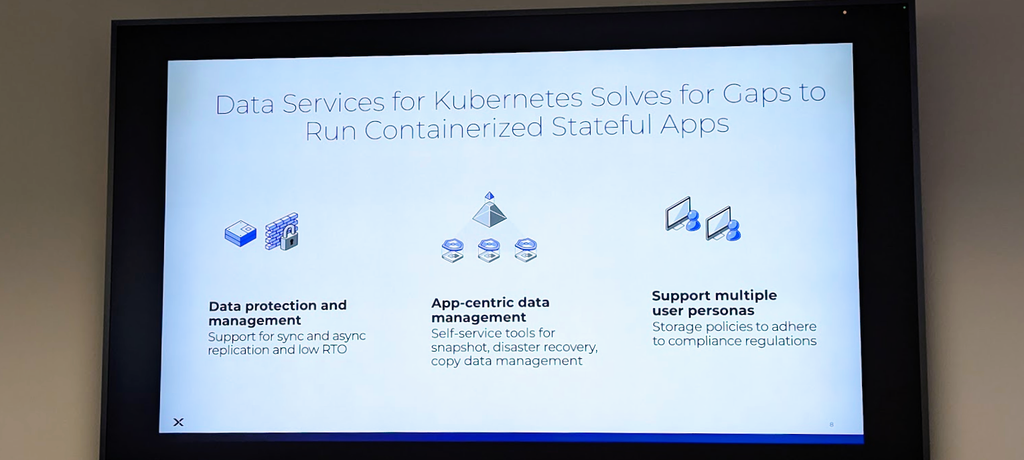
Divyansh sees NDK (Nutanix Data Services for Kubernetes) as the piece that lets you move beyond stateless applications, with snapshots and synchronous or asynchronous replication that application teams drive themselves. The goal is to cover NKP on AHV and NKP Metal with CN-AOS, then eventually the management cluster, whose backup currently goes to S3 with Velero, without application data.
The NDK 2.3 release notes, dated September 21 and therefore older than NKP 2.19, suggest waiting for the next compatibility matrix before getting carried away. They bring a web interface, included in the Helm chart, and require at least NKP 2.18.0, AOS 7.5.1 and Prism Central 7.5.1, but neither NKP Metal nor CN-AOS is listed.
Three limitations are worth keeping in mind:
- Consistency: it is not guaranteed between file shares and block volumes of the same application (ENG-823426).
- Replication: it goes from one cluster to a single other cluster (ENG-756494), with the same Kubernetes distribution on both sides.
- CN-RWX: it only appears in a known issue (ENG-923368), with pods stuck in Terminating after a site-wide storage failure.
On the CN-AOS side, the guide limits DR (disaster recovery) on EKS to asynchronous replication, with an RPO (the maximum acceptable data loss) of one hour or more. That is a long way from the synchronous replication announced for NDK in general.
My take on NKP Metal and CN-AOS
I have not tested anything, so I will stick to the use cases that seem most obvious to me: dense GPU-based AI infrastructure, disconnected or branch office edge environments, and IT departments looking to unify their management. On these three fronts, removing the hypervisor makes sense, and the mixed cluster strikes me as the most reasonable way in.
Above all, these sessions made me want to really find the time to get into it, before NKP slips onto my 2028 roadmap.
Yannick also presented what comes next, but it is under NDA, so you will not get any more out of me… If you want other perspectives on that day, I invite you to read the write-ups by Jeroen Tielen and Patrick Damen.
And you, are you considering running Kubernetes without a hypervisor?
0 comments